DIKSHYA YUGASHAKTI | WEB DEVELOPER

Get In Touch
- Phone 7894913233
- Email dikshyayugashakti456@gmail.com
- Address Odisha, Cuttack 754221
- Follow us


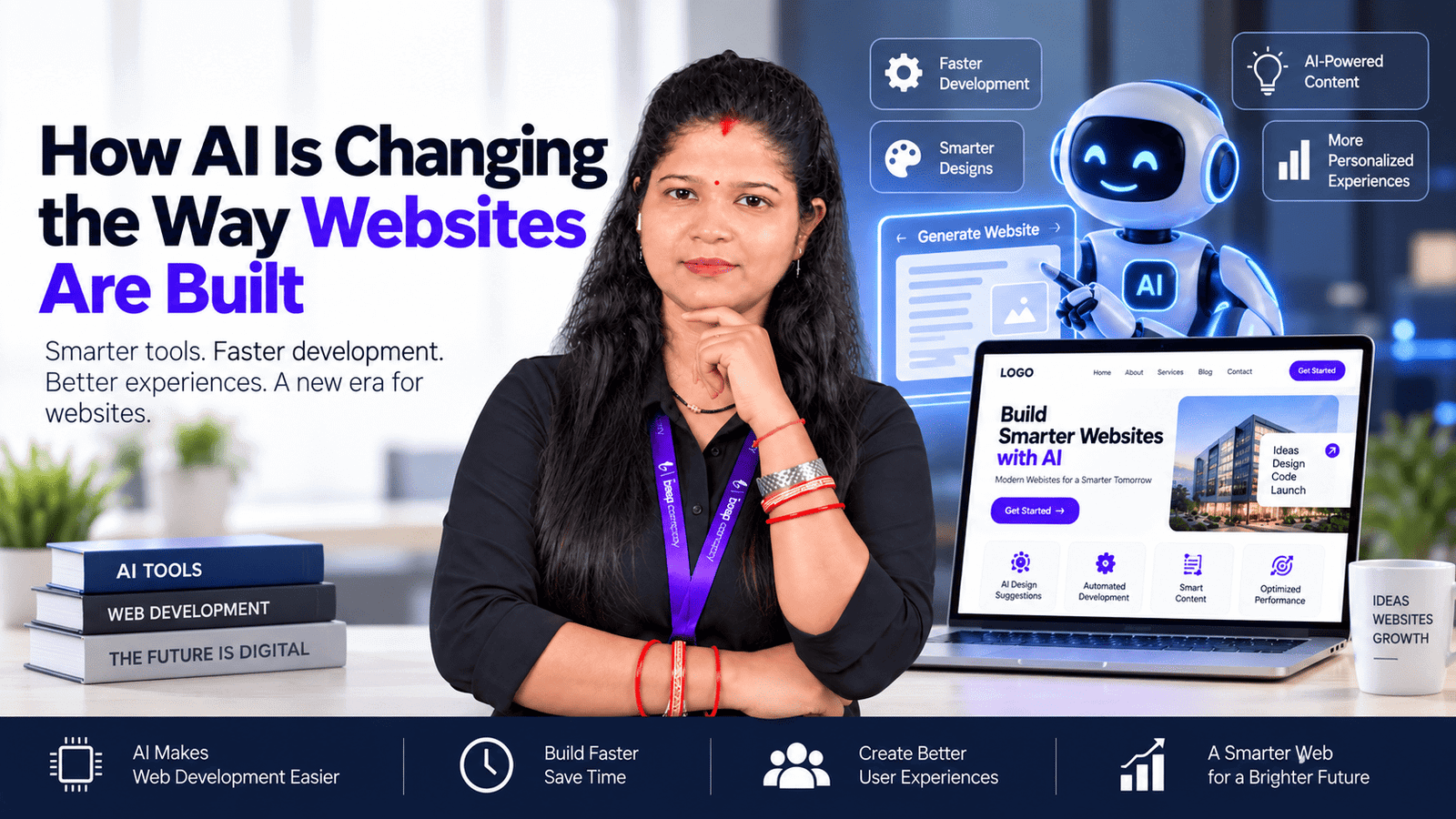
How AI Is Changing the Way Websites Are Built
Artificial Intelligence is changing the way websites are planned, designed, developed, optimized, and maintained. Tasks that once required hours of manual work can now be supported by AI tools, allowing developers to work faster and explore ideas more efficiently.
But AI is not simply replacing traditional website development. Instead, it is becoming another powerful tool in the developer’s workflow.
From generating content ideas and writing code to creating layouts, analyzing websites, improving SEO, and identifying performance issues, AI is becoming part of the modern web development process.
“AI can make development faster, but great websites still require human thinking, creativity, experience, and attention to detail.”
AI Is Changing the Development Process
Traditionally, building a website involved multiple stages of planning, designing, coding, testing, optimizing, and launching.
AI can now assist across many of these stages.
A developer can use AI to brainstorm website structures, generate initial content ideas, explore design concepts, create code snippets, identify errors, and improve existing solutions.
This does not mean that a developer simply enters a prompt and receives a finished website.
The developer still needs to understand the project, evaluate the output, make decisions, customize the result, test everything, and ensure that the final website actually meets the business requirements.
1. Faster Website Planning
Before development begins, there is usually a lot of planning involved.
AI can help developers generate sitemap ideas, page structures, content outlines, feature suggestions, and user journeys based on the business requirements.
This can reduce the time spent starting from a blank page and provide useful directions during the early stages of a project.
However, the final structure should always be based on the actual business and its audience rather than blindly following AI-generated suggestions.
2. AI-Assisted Coding
AI coding tools are becoming increasingly useful for developers.
They can help generate code snippets, explain existing code, identify potential errors, suggest improvements, and assist with repetitive development tasks.
For frontend development, AI can support work involving HTML, CSS, JavaScript, React, and other technologies.
The biggest advantage is not simply generating code faster. It is reducing repetitive work so developers can spend more time solving the actual problems of the project.
3. Smarter WordPress Development
AI is also becoming increasingly useful in WordPress workflows.
Developers can use AI to assist with content creation, page structure, SEO optimization, custom code, troubleshooting, product descriptions, and other repetitive tasks.
For WordPress websites, this can make certain parts of development and content management more efficient.
But plugins, themes, custom code, and AI-generated solutions still need to be properly reviewed and tested before being used on a live website.
4. Better Content Creation
Content is one of the most time-consuming parts of building a website.
AI can help create first drafts for service descriptions, blog outlines, product descriptions, headlines, FAQs, and other website content.
This can be especially useful when a business has limited information available at the beginning of a project.
However, good website content should still sound human and reflect the actual business. AI-generated content should be reviewed, refined, and customized instead of being published without editing.
5. AI and Website SEO
AI is also changing how developers and marketers approach SEO.
It can help with keyword research ideas, content structures, topic suggestions, metadata drafts, content analysis, and identifying areas that may need improvement.
Search is also evolving as users increasingly interact with AI-powered search and answer systems.
This makes it more important for websites to provide useful, well-structured, trustworthy, and clearly written content.
SEO is no longer just about adding keywords to a page. The overall quality and usefulness of the website experience matter too.
6. Faster Design Exploration
AI can help designers and developers explore different visual directions quickly.
Ideas for layouts, color combinations, typography, imagery, sections, and user interfaces can be generated and tested much faster than before.
This gives developers more opportunities to experiment before settling on a final direction.
Still, a good design needs human judgment. Understanding the brand, target audience, industry, and business goals cannot be completely replaced by automated suggestions.
“The faster we can explore ideas, the more important it becomes to know which ideas are actually worth building.”
7. Improved Testing and Optimization
AI can assist developers in identifying potential issues in websites and applications.
It can help analyze code, detect patterns, suggest improvements, and support testing workflows.
Performance optimization can also benefit from AI-assisted analysis, especially when developers are dealing with large websites or repetitive optimization tasks.
But real-device testing remains important. A website should be tested across different screen sizes, browsers, devices, and user scenarios before launch.
AI Does Not Replace the Developer
One of the biggest misconceptions about AI in web development is that anyone can generate a complete website simply by writing a prompt.
In reality, creating a professional website involves much more than generating code.
A developer needs to understand:
- What the business actually needs
- How users will interact with the website
- Which technologies are appropriate
- How different systems should connect
- How the website should perform
- How SEO should be implemented
- How the website should work across devices
- How the final product should be tested and maintained
AI can assist with many of these tasks, but someone still needs to make the right decisions.
The Future of Web Development
AI will likely become an even bigger part of the web development workflow.
Developers may spend less time on repetitive implementation and more time on strategy, architecture, user experience, problem-solving, customization, and quality.
The role of a developer is therefore not becoming less important. It is evolving.
The developers who understand how to combine technical skills with AI tools will be able to work more efficiently while still delivering thoughtful and reliable digital experiences.
Final Thoughts
AI is changing how websites are built, but the fundamentals of good web development remain important.
A website still needs a clear purpose, strong user experience, responsive design, good performance, useful content, proper SEO, and reliable functionality.
AI can help us get there faster. It can help generate ideas, automate repetitive work, solve problems, and explore possibilities.
But the final quality still depends on the people behind the project.
The future of web development is not simply AI versus developers.
It is AI working alongside developers to build better digital experiences.
About the Author
Dikshya Yugashakti
Web Developer | WordPress Developer
With 5.6+ years of experience, Dikshya specializes in WordPress development, WooCommerce, frontend development, SEO, website performance, responsive design, and complete website delivery. She has worked on websites across healthcare, technology, manufacturing, education, e-commerce, corporate, government, real estate, and other industries.
Location: Bhubaneswar, Odisha, India – 754221
WhatsApp: +91 7894913233
Call: +91 93592 24984
Email: dikshyayugashakti456@gmail.com
Turning Ideas Into Digital Reality